
Slushbox
Pharma bolted a Ferrari engine to a 1970s transmission. The industry is now, slowly, looking under the bonnet.

There’s a thing old car people (like me) call a “slushbox.” It’s the classic American automatic - Powerglides, Dynaflows, TorqueFlites - that Detroit bolted behind its engines from the fifties through the eighties. There’s no solid mechanical link between engine and wheels. The engine spins an impeller, the impeller flings fluid at a turbine, the turbine eventually gets the message and turns the driveshaft. Power arrives. Eventually. With a slosh.
The slosh was a feature, not a bug, in fairness - they were aiming for smoothness. The fluid coupling smoothed the shifts and saved the engine (ever bigger, brute force, glorious V8s…) the abrupt argument a manual clutch has with a gearbox. But you always paid for the comfort in response - foot down, the engine roared (a glorious V8 roar…), and a beat passed before the car remembered what you had asked of it. Detroit sold that as refinement for forty years, up until the Germans and the dual-clutch showed everyone what a transmission felt like when it was actually connected to something, and “slushbox” became the punchline it still is.
I keep coming back to it, partly because I’m a car guy, but also because pharma has spent the last few years building itself a genuinely excellent engine, and bolting it to a gearbox that would look at home under a 1974 Buick.
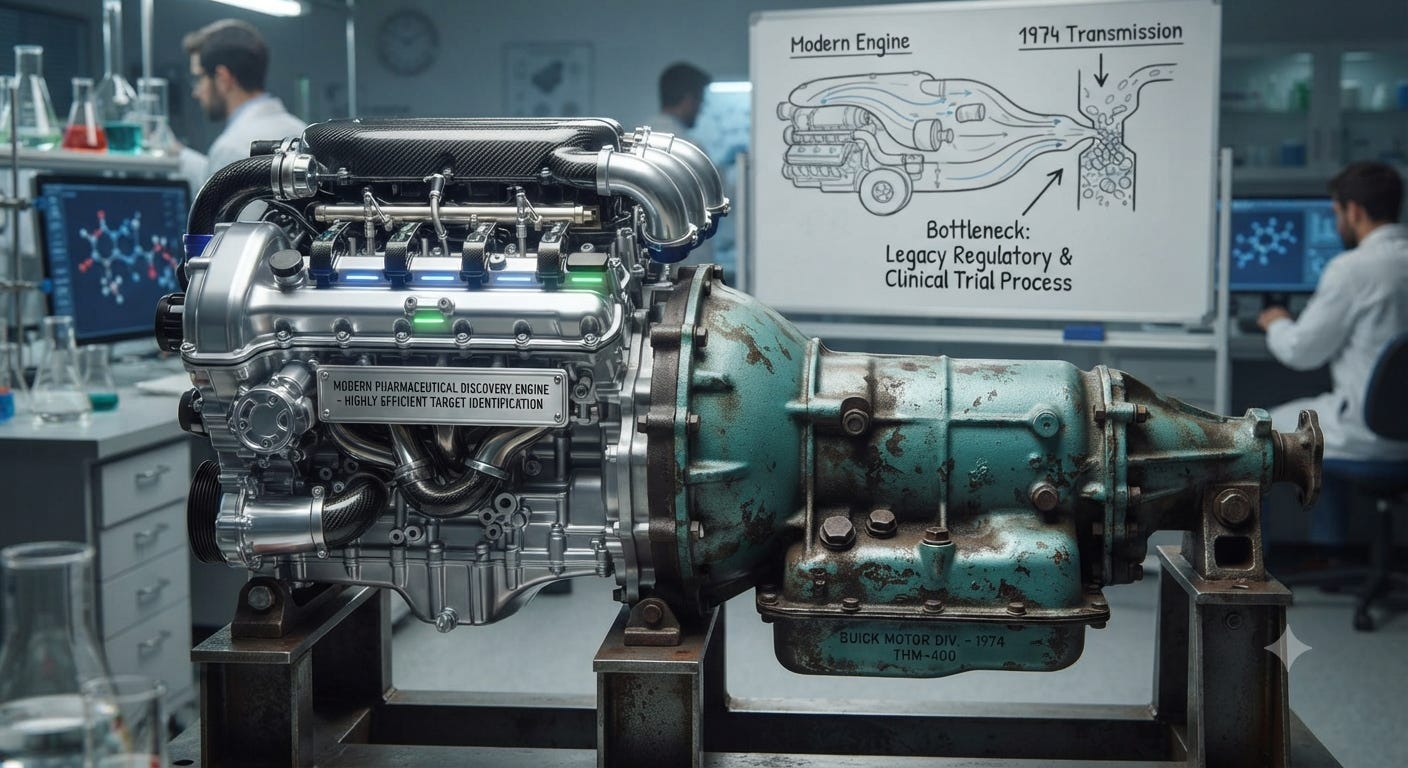
The engine - target ID, molecule design, the whole discovery stack - has had a proper couple of car decades. Insilico Medicine took an AI-designed TNIK inhibitor, rentosertib, from idea to Phase IIa data good enough for Nature Medicine in a fraction of the usual time (and by this month it’s into Phase III) - with an inhaled version already cleared by the FDA for its own trial, reportedly the first fully AI-designed molecule to go straight for the lungs. Exscientia was running eleven-month design cycles with a tenth of the usual compound count before most people took the approach seriously; it’s since been folded into Recursion, because it seems that the fastest way to build a bigger engine is to go and buy someone else’s (as with the car industry). AlphaFold handed the industry the shape of nearly every protein worth having. mRNA went from curiosity to platform in eighteen months flat because a pandemic left it no choice. GLP-1s turned a diabetes side-line into a bigger commercial force than PD-1/PD-L1 inhibitors - oncology's own blockbuster class - inside a few short years.
Yes, bigger…
Drug vs. drug: Keytruda is still the single best-selling molecule on Earth - $31.7 billion in 2025 (Merck’s own reporting). No individual GLP-1 product beats it yet.
Class vs. class (GLP-1 vs. PD-1/PD-L1 specifically): Lilly’s tirzepatide franchise (Mounjaro + Zepbound) did $36.5 billion in 2025; Novo’s semaglutide franchise (Ozempic + Wegovy + Rybelsus) did $36.2 billion. That’s two GLP-1 franchises, each individually bigger than Keytruda alone. Add the rest of the PD-1/PD-L1 field - Opdivo (roughly $9 billion - talk about a blown lead…), Tecentriq, Imfinzi, Libtayo and the rest - and the whole PD-1/PD-L1 class comes in somewhere around $50–55 billion combined. GLP-1s, even just from Lilly and Novo’s two lead franchises, are already past $70 billion. So class-to-class, GLP-1 has very likely overtaken PD-1/PD-L1 as of 2025, and analysts had been flagging this crossover as imminent as early as the 2024 numbers.
None of that’s just marketing. The molecules are better, the search space is bigger, the feedback loops are tighter. The engine is running properly hot (or cold - heat is wasted energy…).
And then there’s the gearbox. (I always get distracted by gearboxes - when I got to the first car I loved, way back, it would be running around 3500rpm at 70mph in top gear. Now, many cars will be doing 1200-1300rpm at the same speed, while sipping a lot less petrol per rev.)
A new drug still takes the thick end of a decade and a half from idea to approval. Cost per approved asset hit $2.23 billion last year, according to Deloitte, up again from $2.12 billion the year before - this despite everyone still insisting that new tools would finally bend that curve downward. Fewer than one in ten compounds that reach Phase 1 ever reach a patient. Phase 2 is still where good drugs go to die, at something like a 60 percent failure rate. My friend Bernard Munos spent years documenting that pharma’s output of new drugs per company has barely moved in sixty years, however much money gets thrown at it; Another friend, Jack Scannell, and his co-authors gave the whole grim pattern a name in 2012 - Eroom’s Law (Moore’s backwards, drugs per billion dollars of spend roughly halving every nine years). Two economists, two different routes into the data, the same number staring back at both of them: the industry keeps getting better at making candidates and no better at turning them into medicines.
The bottleneck moved. It used to sit upstream - find the target, find the molecule, survive lead optimisation. We’ve more or less cracked that bit now. It sits downstream instead, and downstream hasn’t shifted much at all. The FDA still wants the same tox packages and the same GMP scale-up timelines whatever software drew the molecule. A clinical ops team can’t recruit a Phase 3 any faster for knowing the crystal structure. The engine roars, but the car surges forward about eighteen months later than you asked it to.
Slosh
There’s a nastier version of this, and it’s the bit that should worry anyone paid to extract commercial value from a pipeline: the slushbox doesn’t just cost you time, it costs you signal. In a real torque converter, the slip between impeller and turbine turns into heat, which is just wasted energy. Downstream in pharma, the wasted energy is information. A cellular phenotype isn’t a disease. A mouse isn’t a patient. Recursion’s REC-994 cleared its safety bar in Phase 2 for cerebral cavernous malformation and then handed back an efficacy signal thin enough to disappoint everyone - not because the molecule was rubbish, but because the model had been optimised for the cell, and the cell isn’t the system. The coupling ate the signal on the way through.
That’s the real asymmetry. Upstream is now a precision instrument. Downstream is still a torque converter built for an era when the engine was the unreliable part, plus everybody wanted the slack.
Hope
Here’s the bit I didn’t expect to be writing eighteen months ago: someone appears to be trying to fit a lock-up clutch.
The FDA’s new Commissioner’s National Priority Voucher scheme promises reviews in one to two months instead of ten, using what Marty Makary calls a “tumour board” approach - a multidisciplinary team working a submission all at once instead of relay-racing it through departments. Nine vouchers went out last October; the first full approval under the scheme, a GSK antibiotic, landed within months. The agency’s also rolled out Elsa, an agency-wide generative AI tool for its own reviewers, which is the loveliest irony going: the regulator trying to fix its own slushbox with the same species of technology that built the better engine upstream, and picking up exactly the same “can we actually trust what this thing just told us” headache for its trouble.
Europe’s having a go too, in its own European way, with the new Joint Clinical Assessment replacing twenty-seven overlapping national HTA reviews with one.
On the clinical side proper, digital twins and AI-generated synthetic control arms are starting to do real work - using a patient’s own data to shrink or replace a control group, with the FDA already at the table on the methodology. And when a ten-month-old in Philadelphia needed a gene-editing therapy built for a mutation nobody else on Earth has, the agency found a “plausible mechanism” pathway and got it done in months rather than years - proof the whole apparatus can move fast when the alternative is watching a baby run out of time, which rather undercuts the idea that regulatory inertia is some fixed law of nature rather than a default setting somebody chose.
Don’t get carried away, mind. The same period also produced Most Favored Nation pricing orders and tariff threats, stacked on top of the payer and HTA friction that was already there - a new kind of commercial slip that has nothing to do with trial design and everything to do with Washington. And industry R&D returns climbing to 5.9 percent sounds like the transmission’s fixed itself, until you notice that’s almost entirely GLP-1s doing the work; strip them out and it’s 3.8 percent, barely off last year’s number. Obesity is carrying the whole “things are improving” headline on its own back. (Remember when many companies tried to exit exactly that area a couple of decades ago, much as they’re trying in neuroscience now…)
Acceleration
The lesson from Detroit is that you don’t fix a slushbox by fitting a bigger engine. The actual lock-up clutch arrived in 1949 - and then took the best part of three decades to become something drivers would trust, by which point the slushbox itself still had another thirty-odd years left to run before anyone seriously killed it off. First attempts at a fix are usually clunky, occasionally wrong, and slower to earn trust than the people who built them would like.
Which is roughly where pharma’s new gearbox sits today. Voucher pilots. An AI reviewer nobody’s quite sure they trust yet. Digital twins doing their first proper trial work. A regulatory pathway invented for exactly one baby. It’s not a finished transmission. It’s 1949.
The engine's better than it's ever been. Nobody's short of horsepower any more, and nobody's going to stop building more powerful engines (fingers crossed) - that trade isn't dying, it's just stopped being where the game's won. The game's the clutch now: who gets it to lock up reliably first, and who's still explaining to the board why the car surges forward half a second after everyone's already put their foot down.